REPORT: 2024 – A Year Of Climate Disasters
Climate Change Continues To Affect All Of Us
Last Updated: 12/10/24
2024 has been another difficult year for Americans, with an above-average hurricane season, catastrophic flooding, the hottest summer on record, and historic drought conditions. Yet some continue to deny the reality and ongoing effects of climate change.
2024 has seen records broken for wildfires, heat waves, storms, and hurricanes – with the final toll of these disasters still being calculated. As of December 6, 2024, the United States had endured 24 extreme weather events that cost at least $1 billion each in 2024. 100% of people living in the U.S. were under an extreme weather alert from May through October 2024.
As we’re witnessing year after year, climate change isn’t something distant or limited to specific events, such as wildfires or major hurricanes, but rather impacts Americans across the country every single day.
Top Ten Climate Impacts Of 2024
- Another Active Atlantic Tropical Storm Season: This year’s Atlantic Hurricane season saw above-average activity with 18 named storms, including 11 hurricanes, five of which intensified to major hurricanes.
- Hurricane Beryl Was The Strongest July Atlantic Hurricane On Record: On July 2, 2024, Beryl became the earliest Category 5 hurricane observed in the Atlantic on record and only the second Category 5 hurricane to occur in July. At max strength, Beryl became the strongest July Atlantic hurricane on record, with winds of 165 mph. Hurricane Beryl cost $7.2 billion in damages and killed 45 people.
- Hurricane Helene Was The Deadliest Hurricane To Strike The U.S. Mainland Since 2005: On September 26, 2024, Hurricane Helene, with 140 mph sustained winds, was the strongest hurricane on record to strike the Big Bend region of Florida. With 225 people killed, Helene was the deadliest Atlantic hurricane since Maria (2017) and the deadliest to strike the U.S. mainland since Katrina (2005). Helene released historic rainfall of over 30 inches, which led to catastrophic flooding across western North Carolina. Helene caused severe economic, agricultural, infrastructure, and health impacts across southern states.
- Hurricane Milton Became The Gulf Of Mexico’s Strongest Late-Season Storm On Record: Less than two weeks after Helene, on October 9, 2024, Hurricane Milton, with 120 mph sustained winds, made landfall near Siesta Key, Florida. Based on wind speed, Milton became the strongest hurricane in the Gulf of Mexico since Hurricane Rita in 2005. Milton also spawned 46 tornadoes and caused torrential rainfall and localized flooding.
- 2024 Marked The Hottest Summer On Record Worldwide: According to NASA, the summer of 2024 was Earth’s hottest since global records began in 1880. The summer of 2024 was 2.25 degrees Fahrenheit hotter than the average summer between 1951 and 1980. Between June 1 and August 31, 6,871 highest daily maximum temperature records were broken, and 3,298 records were tied in the U.S. alone.
- 2024 Is On Track To Be The Hottest Year On Record: 2024 is on track to be the hottest year on record after an extended streak of exceptionally high monthly global mean temperatures. From January to September 2024, global temperatures were 1.54 degrees Celsius above the pre-industrial average.
- Extreme Heat Deaths Continued To Rise: Extreme heat remains the biggest weather-related killer in the U.S. 2024 saw intense heat waves that would have been virtually impossible without climate change, shattered daily temperature records, and left millions across the U.S. to deal with dangerously high temperatures. Arizona’s Maricopa County has seen nine back-to-back record-setting years for extreme heat deaths. As of October 26, 2024, Maricopa County confirmed 466 heat-associated fatalities. The county is still investigating 191 cases and, if confirmed, will put 2024 above 2023’s 645 heat-related deaths. As of December 3, 2024, Clark County, Nevada, has confirmed 491 heat-related deaths.
- Record Drought Impacted All But Two States: During the last week of October, almost the entire U.S. faced drought conditions. According to the U.S. Drought Monitor, 48 states had at least moderate drought conditions, a record in the monitor’s history. 100 weather stations across 26 states reported their driest October on record.
- Climate Change Fueled Wildfires In The Northeast: Amid an unusually severe drought in the region, hundreds of wildfires engulfed the Northeast, including parts of Connecticut, Massachusetts, New York, New Jersey, and Pennsylvania.
- Americans Experienced Dangerous Air Quality: Nearly 4 in 10 Americans (131.2 million) still live in places with failing grades for unhealthy particle pollution or ozone levels. In 2024, the majority of the 119 counties earning failing grades for year-round particle pollution are in the western U.S., likely due to wildfires and extreme heat. People of color are 2.3 times more likely than white people to live in counties with failing grades across all three pollutant categories.
Year-To-Date Key Stats
Number Of Atlantic Storms: 18 named storms (including 11 hurricanes, 5 of which were considered major)
Number Of Category 3 Or Higher Hurricanes: 5 (Beryl, Helene, Kirk, Milton, and Rafael)
Number Of Deaths From Billion-Dollar Hurricanes And Tropical Storms: 304 U.S. deaths
Number Of Deaths From Billion-Dollar Severe Storms: 51
Number Of Deaths From Billion-Dollar Winter Storms: 61
Number Of Deaths From Billion-Dollar Wildfires: 2
Total Deaths From Climate-Related Events As of 12/6/2024: 418
Estimated Damage Costs From Climate Disasters Through December: $61.6 billion (Hurricane Helene and Hurricane Milton still to be counted)
Wildfire Acres Burned As Of 12/6/2024: 8,406,135
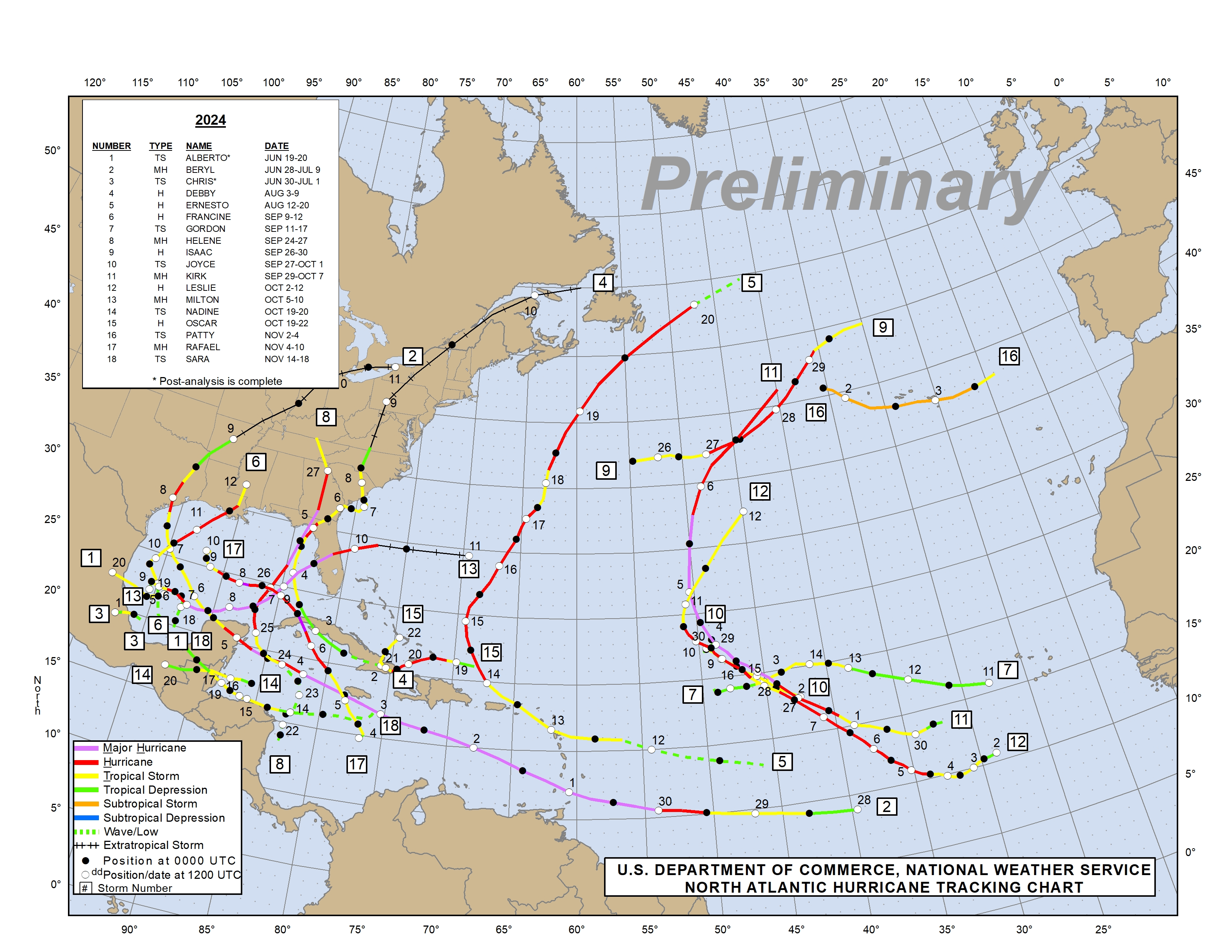
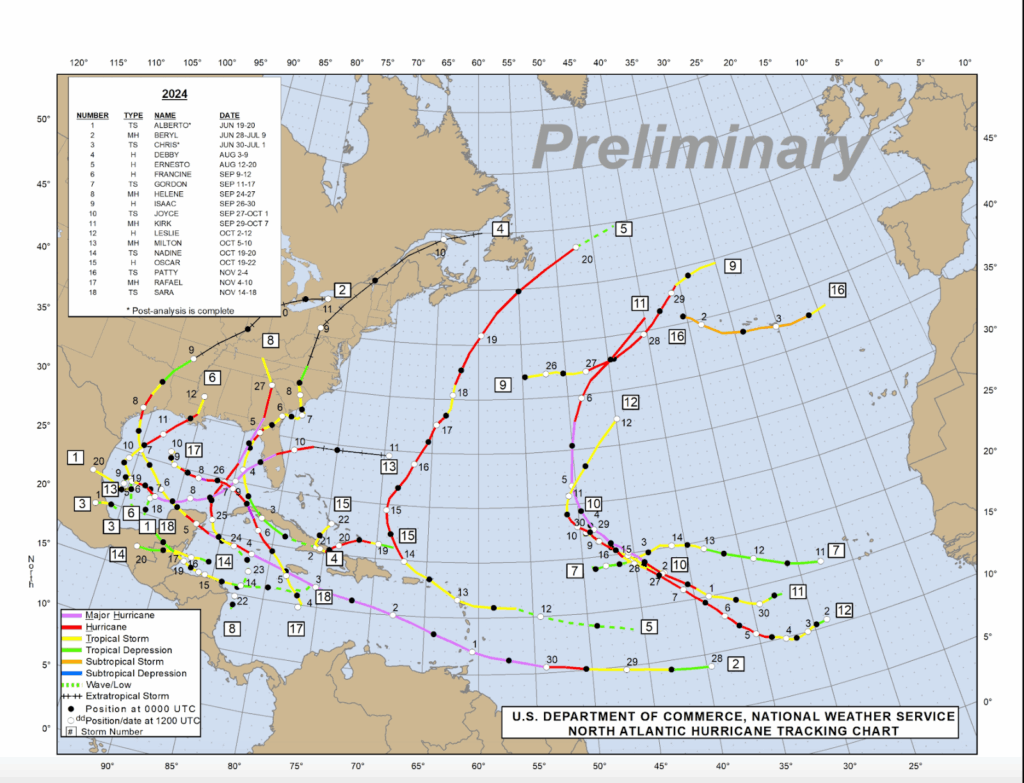
2024 Track Map Of Storms Alberto Through Sara1
Historical Comparisons
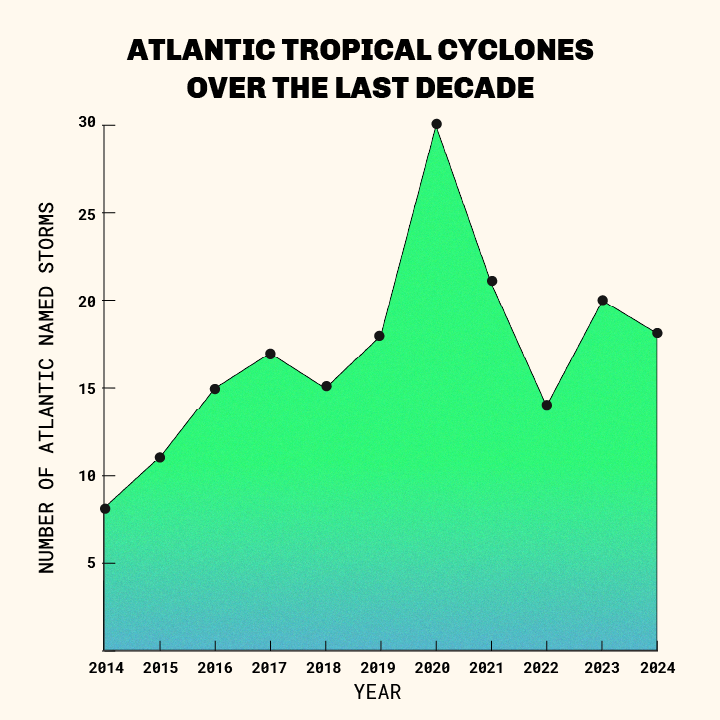
In May 2024, NOAA warned of an “above-normal” Atlantic hurricane season, expecting 17 to 25 named storms, including 8 to 13 hurricanes. The Atlantic has not had a below-average season, per NOAA’s definition, since 2015. With 18 named storms, 2024 was an above-average season. Seven hurricanes formed in the Atlantic since September 25 – the most on record for this period.
Atlantic Tropical Cyclones Over Last Decade2
Additional Atlantic Cyclone Data From The Past Decade3
| Year | Atlantic Named Storms | Atlantic Hurricanes | U.S. Deaths From Tropical Cyclones | U.S. Damage Costs From Tropical Cyclones (Billions of Dollars) | Accumulated Cyclone Energy (ACE) | Named Storm Days |
|---|---|---|---|---|---|---|
| 2014 | 8 | 6 | 66.7 | 35 | ||
| 2015 | 11 | 4 | 62.7 | 43.5 | ||
| 2016 | 15 | 7 | 49 | 11 | 141.3 | 81 |
| 2017 | 17 | 10 | 3167 | 278.2 | 224.9 | 93 |
| 2018 | 15 | 8 | 102 | 50.4 | 129 | 87.25 |
| 2019 | 18 | 6 | 15 | 6.7 | 129.8 | 68.5 |
| 2020 | 30 | 13 | 91 | 51 | 179.8 | 118 |
| 2021 | 21 | 7 | 104 | 82.5 | 145.7 | 79 |
| 2022 | 14 | 8 | 182 | 120 | 95.1 | 56.25 |
| 2023 | 20 | 7 | 5 | 3.6 | 145.6 | 99 |
| 2024 | 18 | 11 | 304 | 9.7* | 161.7 | 77.25 |
*Total damage costs from Hurricane Helene and Hurricane Milton are still to be counted
Wildfires4
As of December 4, 2024, wildfires have burned more than 8.1 million acres. From June to July 2024, several wildfires in New Mexico destroyed over one thousand structures, costing $1.7 billion in damages and killing two people. Wildfires are no longer just a problem for the western U.S. Amid an unusually severe drought, hundreds of wildfires have engulfed the Northeast, including parts of Connecticut, Massachusetts, New York, New Jersey, and Pennsylvania.
| Year | Wildfire Acres Burned (millions of acres – full year) | Year-To-Date # of Fires by December 6th | Year-To-Date Acres Burned by December 6th |
|---|---|---|---|
| 2014 | 3.6 | 51,806 | 3,486,180 |
| 2015 | 10.13 | 56,206 | 9,799,444 |
| 2016 | 5.51 | 60,670 | 5,281,273 |
| 2017 | 10.0 | 57,981 | 9,283,968 |
| 2018 | 8.8 | 52,743 | 8,506,909 |
| 2019 | 4.7 | 47,911 | 4,687,111 |
| 2020 | 10.1 | 53,176 | 9,597,996 |
| 2021 | 7.1 | 54,929 | 6,810,297 |
| 2022 | 7.5 | 61,499 | 7,424,080 |
| 2023 | 2.6 | 53,381 | 2,606,304 |
| 2024 | 8.4* | 52,447 | 8,406,135 |
*YTD from 1/1/24 through 12/06/24
Extreme Heat & Drought Records
Extreme heat records were broken both on a global scale and in locations throughout the United States in 2024. Here are just a few examples:
- The World Meteorological Organization confirmed that 2024 will be the hottest year ever recorded on Earth.
- August 2024 was the 15th month in a row to set a new monthly record for heat on Earth.
- From June to August 2024, 2 billion people (25% of the global population) experienced 30 or more risky heat days that were made at least three times more likely by climate change.
- Over 91 million people in the U.S. (27% of the population) experienced 30 or more risky heat days that were made at least two times more likely by climate change.
- From June to August 2024, 26 U.S. cities had at least one dangerous extreme heat wave, meaning that it had at least five consecutive days hotter than 99% of temperatures recorded in that city from 1991-2020.
- More than 6,000 daily heat records were broken in the U.S. this summer.
- According to the National Oceanic and Atmospheric Administration, July 2024 was the hottest July on record, and August 2024 was the hottest August on record globally.
- In 2024, Phoenix, Arizona, faced a streak of 113 consecutive days of highs reaching at least 100 degrees. In 2024, the city also saw 61 days of highs reaching 110 degrees.
- Since 2000, western North America has experienced the driest 25-year period in at least 1,200 years. Climate scientists estimated that about 40% is attributable to warming driven by the burning of fossil fuels and rising levels of greenhouse gases.
- The average October precipitation across the Lower 48 was 0.95 of an inch — 1.21 inches below average — tying October 1963 as the second-driest October on record.
- During the last week of October, almost the entire U.S. faced drought conditions. According to the U.S. Drought Monitor, 48 states had at least moderate drought conditions, a record in the monitor’s history.
- According to the October 29 U.S. Drought Monitor report, 87.16% of the contiguous U.S. was experiencing abnormally dry to exceptional drought conditions — a record in the program’s 25-year history.
- 100 weather stations across 26 states reported their driest October on record.
From September 29 to November 10, no measurable precipitation was recorded in Philadelphia, Pennsylvania. The previous record was 29 days and set in 1874.
- https://www.nhc.noaa.gov/tafb_latest/tws_atl_latest.gif ↩︎
- Colorado State University North Atlantic Ocean Historical Tropical Cyclone Statistics ↩︎
- http://tropical.atmos.colostate.edu/Realtime/index.php?arch&loc=northatlantic
https://tropical.atmos.colostate.edu/Realtime/index.php?loc=northatlantic
https://www.ncei.noaa.gov/access/billions/summary-stats/US/2022 ↩︎ - https://www.nifc.gov/fireInfo/nfn.htm ↩︎